sábado, 7 de janeiro de 2017

A Lula mais especial| The most special squid!!!


Estamos agora a caminho de uma área mais fascinante dos Oceano, a Frente Polar Antártica (onde as águas frias do Oceano Antártico se juntam às águas mais quentes a norte), no congelador já temos amostras muito interessante, da Geórgia do Sul, que nos vão ajudar a perceber como funciona a cadeia alimentar Antártica. Em particular, o impacto que os de metais pesados podem ter no ecossistema marinho desta região da Antártida. Recolhemos desde amostras de água, a peixes e lulas, passando por diversas espécies de zooplâncton.


A água, recolhidas pelo equipamento CTD (que regista dados de condutividade, temperatura e densidade da água a diferentes profundidades), vai nos dar um valor base de contaminação para esta região.  Recolhemos alguma das espécies de camarão (ex. Euphausia superba, Euphausia frigida, Euphausia triacantha e Themisto gaudichaudii), lulas (Galiteuthis glacialis, Psycroteuthis glacialis, Sloczarcykovia circumantarctica) e de peixes (ex. Gymnoscopelus braueri, Gymnoscopelus nicholsi e Protomyctophum bolini) mais abundantes nesta região foram recolhidas  durante a Western Core Box (uma área de estudo importante há muitos anos junto à Geórgia do Sul). Recolhemos estas amostras utilizamos diferentes tipos de rede, normalmente à noite pois é mais fácil capturar, pois os animais não conseguem ver a rede: quanto menor a malhagem (tamanho dos buracos da rede), mais pequenos são os organismos. 


Assim, usamos as RMT8 (Arrastro retangular pelágico, o que significa basicamente uma rede retangular que tenta apanhar animais no meio da (coluna de) água) principalmente para os camarões ou zooplâncton (pequenos organismos marinhos). Com a rede RMT25, com malhagem maior, esperamos apanhar mais peixe e lulas. No primeiro dia deste ano novo tivemos o privilégio de apanhar uma lula muito especial, Histioteuthis (or Sigmatoteuthis) eltaninae


Esta lula é especial pois já a conheço há quase 20 anos, mas só através dos seus bicos que encontro nas dietas dos pinguins, focas e albatrozes. Finalmente hoje, conseguimos ver um individuo desta espécie inteiro pela primeira vez! Sorriso gigante! Encontra esta lula foi como conhecer pessoal os escritores dos nossos livros de infância. Todas estas amostras são também de particular interesse aos nossos colegas cientistas Ryan Saunders, Sophie Fielding, Stacey Dornan, Rob Blackwell (Reino Unido) e Gabi Stowasser (Alemanha), que estão também a fazer estudos com algumas destas espécies. Há também outras equipas que estão a usar outras redes: o BONGO, MUDL e MOCNESS (malhagem pequena) podem ser usadas em águas de pouca profundidade (ex. BONGO) ou em grande profundidade (MOCNESS) e são ótimas para apanhar organismos pequenos e ainda vivos, excelente para poder-se fazer experiências in vivo (com os animais ainda vivos) em laboratório (utéis aos cientistas Geraint Tarling e Vicky Fowler (Reino Unido), Clara Manno e Elisa Bergami (Itália)). 


Também temos a cientista Angelika Slomska (Polónia) que está interessada em Salpas (organismo gelatinoso chamada Salpa thompsoni) que ainda se conhece pouco... como podem concluir, as nossas noites são extremamente ocupadas, mas sempre muito interessantes!!!! Agora na Frente Polar   espera-mos encontrar mais abundância de animais e espécies completamente diferentes. Entusiasmo é grande!!!! Fica em contato para mais notícias em breve!


We already have a nice group of samples, collected close to South Georgia, to study the Antarctic marine food web, particularly the role of heavy metals in it. The water samples (collected by the equipment called CTD (that measures conductivity, temperature and density and different depths) and different organisms such as the crustaceans (e.g. Euphausia superba, Euphausia frigida, Euphausia triacantha e Themisto gaudichaudii) and fish (e.g. Gymnoscopelus braueri, Gymnoscopelus nicholsi e Protomyctophum bolini) were already obtained at the Western Core Box (an important study area for many years, with numerous cruises of the British Antarctic Survey, close to South Georgia). To obtain these samples we use a wide range of nets, usually at night, when the it is easier to capture the organisms (as numerous species migrate closer to the surface at night). For our research, we use RMT8 (Rectangular Midwater Trawl, with smaller mesh) that can sample the water column very well for zooplankton (e.g. Antarctic krill). The RMT25, which is bigger (with bigger mesh), can also catch faster fish and squid. On the first day of the year, we had the privilege of catching a very special squid, Histioteuthis (or Sigmatoteuthis) eltaninae. I have known this squid for 20 years, but only through their beaks (i.e. the mandibles of the squid) found in the diet of penguins, seals and albatrosses. Finally, I was able to see a complete individual of Histioteuthis eltaninae! I am so happy. It is beautiful! It has photophores around its body, including around its eyes. Interesting enough, one eye is considerably bigger than the other. This is probably to this squid live predominantly in deep waters ( more than 200 meters depth) where the sunlight does not reach. Therefore, having 1 big eye could give an advantage to find prey, find partners and avoid predation. Big smile on our faces!!! All the samples collected are of particular interest, beyond us, to our colleague scientists Ryan Saunders, Sophie Fielding, Stacey Dornan, Rob Blackwell (UK) e Gabi Stowasser (Germany), that also are doing research projects on some of these species. Other research teams are also using other nets: BONGO, MUDL e MOCNESS (all with small mesh) can be used in shallow and deep waters, excellent to catch small zooplankton alive and in good conditions (useful to the scientists Geraint Tarling and Vicky Fowler (UK), Clara Manno e Elisa Bergami (Italy)). We also have the scientist Angelika Slomska (Poland) that is interested in Salps (gelatinous organism called Salpa thompsoni) that is still poorly known but its importance in the Southern Ocean has recently been recognized...as you can conclude, our night have been busy since the new years eve!!! Now we are on our way to another research station in one of the most fascinating ocean areas of the Southern Ocean, the Antarctic Polar Front (where cold water from the Antarctic get together with the warmer waters from the north) where we hope to find a mix of species from Antarctic and sub-Antarctic waters and assess the gradient of trophic interactions and trace levels in this area. Our enthusiasm is high!!!! Keep log on for more news soon...


domingo, 1 de janeiro de 2017

Bom Ano Novo 2017!!! Happy New Year 2017!

Bom Ano Novo de 2017!!! Incrivelmente, o dia foi passado bastante intensivamente pois foi um dos dias de recolha de amostras com a maior rede (RMT25 - Rede de Arrasto Pelágica). Estavamos todos entusiamados! Em verdade, a meia noite foi passada a lançar as redes...mas o nascer do Sol na Antártida valeu a pena! Bom Ano!!!!


Happy New Year 2017!!! What a day! It was spent collecting samples with our biggest net (RMT25 - Rectangular Midwater Trawl). We were very entusiastic! The midnight was spent deploying the net....mas the sunrise was well worth it!!!! Happy New Year!!!

PS The tradition onboard of the James Clark Ross is that the  oldest person onboard rings the bell first and then the youngest person onboard, to welcome the new year!


sábado, 31 de dezembro de 2016

A nossa gente!!! Our crew!!!


Estamos a meio da expedição! Incrível como o tempo voou. Neste período de tempo deu novamente para notar que uma expedição cientifica à Antártida só é possível com o profissionalismo, dedicação e paixão dos oficiais e da tripulação do James Clark Ross, além dos nossos muitos colegas cientistas. O seu esforço continuo é essencial para o sucesso da expedição. E isso nota-se TODOS os dias, com um brilho nos olhos de quem adora do que faz. Sob a supervisão do capitão Timothy Page, e pela cientista principal Sophie Fielding, o James Clark Ross possui um plano cientifico que é revisto diariamente, consoante os objetivos científicos e as condições do mar. Daí ter mencionado as regulares reuniões que temos sobre os vários aspetos da expedição.


 Um dos elementos nucleares é a operação dos aparelhos científicos que são sempre realizados com a supervisão, apoio e execução de vários tripulantes. As principais redes que usamos para recolher amostras, que temos estado a usar, tem sempre a supervisão de Peter Enderlein (com 16 anos ao serviço da British Antarctic Survey com mais de 40 expedições à Antártida), Dan Ashurst e Scott Polfrey, e com a assistência (em tudo, incluindo os guinchos) do Dave Peck (no instituto desde os 16 anos de idade; 31 anos no instituto), Martin Bowen, Samuel English, George Dale,  Alan Howard, Sheldon Smith, Francisco Hernandez e Graham Waylett fazem o apoio essencial nesta operação no convés. 


O navio é guiado por Waveney Crookes, Rob Bellis, Matt Chapman e o cadete Tom Dutton. Se tiverem 1 minuto, conversem com Waveney, Alan ou com o Francisco, que certamente vos inspirará a serem excelentes profissionais, que adoram o que fazem, e revelam aquela paixão pela Antártida que nós, de um ou outro modo, todos possuem. Todos ajudam todos, entreajuda e colaboração são sem duvida o mote das expedições polares. 


E caso haja alguma avaria técnica ligados ao navio, Craig Thomas resolve, tal com o Seth Thomas com questões relacionadas com eletrónica, e o Jeremy Robst sobre questões de informática. Ao nível da rádio e contatos com o exterior, o Mike Gloistein é a pessoa a contatar.


 Os engenheiros Gert Behrmann, Chris Mannion, Marc Laughlan e Steve Amner, com o apoio de Henry Glyndor e Gareth Wale, são fundamentais na operação dos motores do navio e o funcionamento do equipamento motor de um modo perfeito, dirigido por Neil MacDonald. Richard Turner é quem nos recebe a bordo e que torna a nossa vida mais confortável a bordo.  E quanto a comida, um aplauso para aqueles que cozinham (e servem) para nós todos os dias: Colin Cockram e Gary Morgan (com o apoio de Lee Jones, Nicholas Greenwood, Graham Raworth e Rodney Morton).


 Depois de tudo isto, se ficas doente, é só ir ao departamento médico, onde a médica Helen Jones te ajudará. Resumindo: é preciso o esforço continuo diário para que o sucesso de uma expedição seja alcançado. Cada pessoa possui um papel extremamente importante a bordo e isso reflete-se nos resultados. Cada uma das nossas amostras resulta de muito trabalho e dedicação de todos desta equipa fabulosa de tripulantes, oficiais e cientistas a bordo do James Clark Ross. Muito obrigado. Sem vocês, nada disto seria possível!!!!


Amazingly, we are already in the middle of the expedition! Incredible how time flies. It is important to note that an expedition to the Antarctic is only possible with the professionalism, dedication and passion of the officers and the crew of the James Clark Ross, together with our science colleagues. Their continuous dedication is essential for the success of our expedition. And this is noted everyday, with a smile from someone that loves what he/she does. Under the supervision of Captain Timothy Page, and by the Principal Science Officer Sophie Fielding, the James Clark Ross has a detailed scientific plan of the research cruise, reviewed daily, depending on the scientific goals and of the conditions of the sea. Therefore, we have meetings very regularly, to reach consensus and solve any pending issues.


 One of the important elements of the expedition related to our work is the deployment of the scientific equipment (e.g. research nets) that have to be conducted always under the supervision, support and execution of the crew with us scientists. The main research nets that we have been (or will be) using are overseen by our marine engineers Peter Enderlein (16 years at the British Antarctic Survey, with more than 40 Antarctic expeditions), Dan Ashurst and Scott Polfrey. On deck, managed by Chief Officer Iain Mackenzie, the crew assisting (with everything, including the winches) are Dave Peck (at the British Antarctic Survey since he was 16 years old; 31 years of service), Martin Bowen, George Dale, Samuel English, Francisco Hernandez,  Alan Howard, Sheldon Smith and Graham Waylett. The ship is steered by Waveney Crookes, Rob Bellis, Matt Chapman and cadet Tom Dutton. If you ever have a minute, do have a conversation with Waveney Crookes, Alan or Francisco, that certainly will inspire you to be excellent professionals, to find what you love enjoy doing, and understand their passion for the Antarctic that, in one way or another, everyone on board has. Everyone helps everyone. And if there is any technical issues related to the ship, Craig Thomas will solve it; Seth Thomas related to electronic issues, and Jeremy Robst to computing (yes, we have email thanks to him!). Radio and external links is with Mike Gloistein. The engineers, Gert Behrmann, Chris Mannion, Marc Laughlan and Steve Amner, together with the motormen, Henry Glyndor and Gareth Wale , keep the ship's motor equipment in a brilliant state, and are coordinated by chief engineer Neil MacDonald. Purser Richard Turner, who is the first to welcome us onboard, is the first person of contact to help and making his best to make our life confortable (and safe) onboard. And we can not forget to also applaud to those that cook (and serve us) everyday:  Colin Cockram and Gary Morgan (with the great support of stewards Lee Jones, Nicholas Greenwood, Graham Raworth and Rodney Morton). After all of this, if you need any special medical support,  the Doctor Helen Jones will help. In a nutshell: continuous daily effort of all these people is needed so that a scientific expedition reaches success. Each person onboard knows that they play such an important job that is reflected by the good results obtained. Each of the samples collected results of considerable work and dedication of everyone of this fabulous team of crew, officers and scientists on board of the James Clark Ross (plus all the support in Cambridge). Thank you for your excllent work. Without you, it would not be possible!!!!


To learn more about what the James Clark Ross does follow Mike´s blog:
http://www.jcr.nerc-bas.ac.uk/gm0hcq/jcr_update.htm

PS Thank you Jeremy!!!!! 

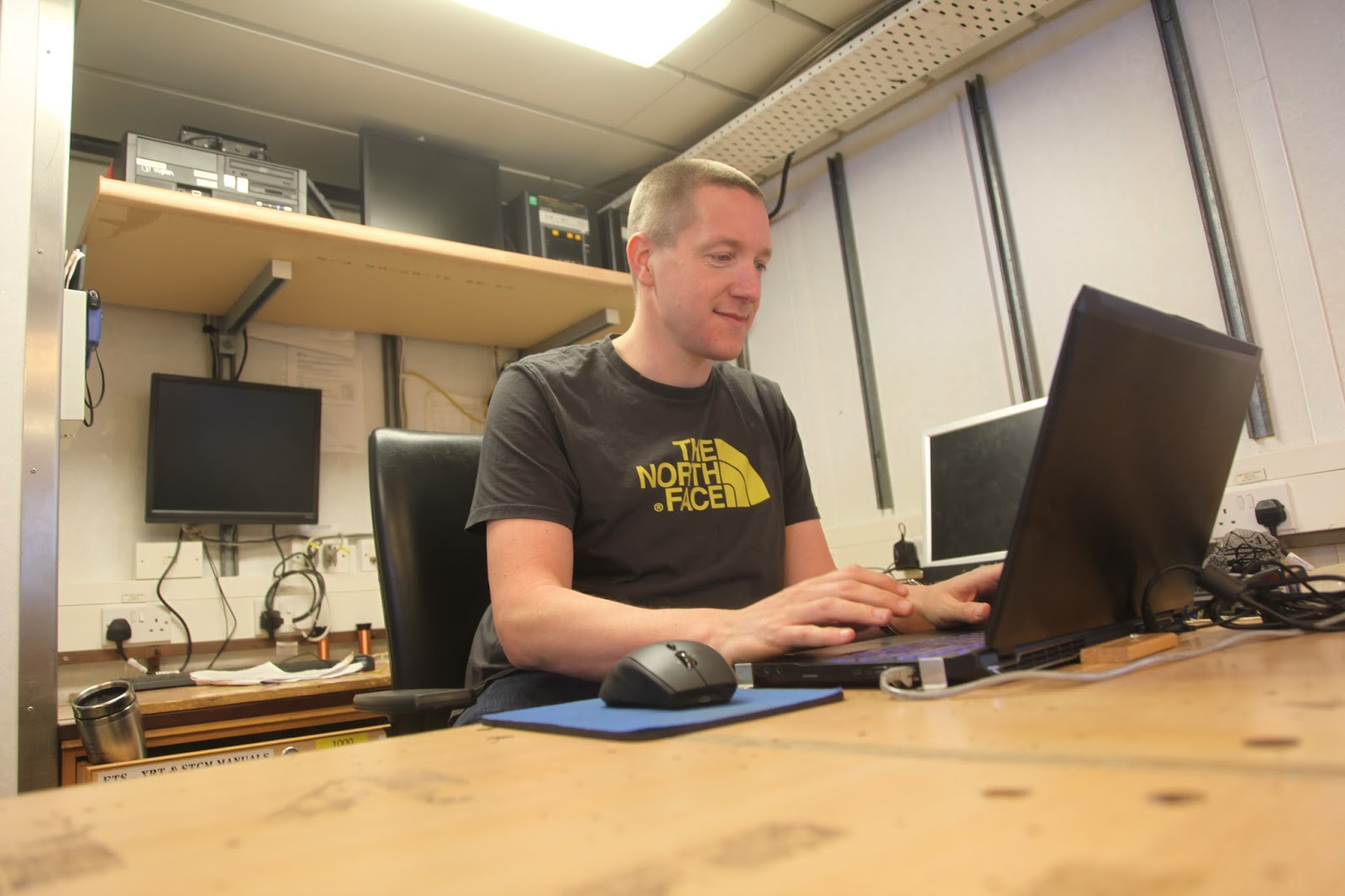
Jose Xavier & Jose Seco